Accessibility in Lucerne
Is Lucerne accessible for wheelchair users?
The station, lake promenade, main shopping streets and SBB trains are step-free and manageable. The medieval old town has genuine cobblestones that make some routes hard going, and not every mountain trip is wheelchair-friendly, so the choice of excursion matters more than the choice of city.
Planning an accessible trip to Lucerne
Switzerland has a reputation for being easy on wheelchair users and anyone with reduced mobility, and in the modern parts of Lucerne that reputation mostly holds up. Where it gets more complicated is the old town: a genuine medieval quarter with real cobblestones, narrow arcades and a scattering of steps that no amount of Swiss engineering has flattened out. This guide separates what actually works from what is sold as accessible but isn’t quite, covering trains, boats, mountains, the old town, and where to find a toilet when you need one. For getting around day to day, read this alongside getting around Lucerne.
None of what follows should be taken as a guarantee. Facilities and staffing on Swiss public transport are generally reliable, but lifts do go out of service and boats vary by vessel. Book assistance ahead where it’s offered, and build slack into the day rather than a tight connection.
Arriving in Lucerne: airport and station
Most visitors arrive via Zurich Airport (ZRH), about an hour away by direct train, or Basel-Mulhouse (BSL), roughly ninety minutes. Both airports have step-free access from the terminal to the platform, lifts to every level, and staff who can arrange a ramp for the train if you book ahead through SBB. See Swiss trains explained for how the booking and boarding assistance system works in practice.
Luzern Bahnhof itself is flat, well-lit and has lifts to every platform. It sits directly beside the lake and the main boat piers, which is one of the more useful pieces of Lucerne geography for anyone who doesn’t want to walk far between transport modes: train, bus and boat are within a few minutes of each other, all on the level. Left-luggage lockers at the station are at a mix of heights; see luggage and left-luggage in Lucerne if you need to store a bag and continue with less to carry.
Trains: what actually happens on the day
SBB (the Swiss federal railway) carries a wheelchair space and a manual boarding ramp on its InterCity and RegioExpress services, and an accessible toilet on longer routes such as Lucerne–Zurich, Lucerne–Bern and Lucerne–Basel. The system depends on notice: call the SBB Call Center Handicap on 0800 007 102 (from within Switzerland) at least one hour before travel, or use the accessibility booking option in the SBB app, and give your train time and platform. A member of staff will be on the platform with the ramp when the train arrives.
Without pre-booking, boarding still usually works on newer double-deck trains with low-floor doors, but older single-deck stock can have a step of 20 to 30 centimetres that no one is standing by to bridge. If your itinerary includes regional trains to smaller destinations, assume you’ll need the ramp and book it.
A Swiss Travel Pass or Half Fare Card doesn’t change any of this directly, but it does remove the need to queue at a ticket machine that may be mounted too high to reach comfortably from a wheelchair. Details on which pass suits which trip are in the Swiss Travel Pass guide.
Boats on Lake Lucerne
The five historic paddle steamers and the newer motor vessels that make up the Lake Lucerne fleet vary in how accessible they are. The larger paddle steamers generally have a step-free main deck and a lift or stairlift to the saloon below; older or smaller boats may only offer the open deck without lift access to lower levels. None of this is obvious from the timetable alone, so it’s worth calling the Lake Lucerne Navigation Company ahead of a specific sailing, or asking crew at the pier before boarding.
Piers themselves are mostly level with the boat, but the gap and step height shift with the lake’s water level through the season, so a pier that’s flush in July can have a small step in a dry autumn. Crew will usually put out a portable ramp if asked. For the practical side of times, piers and which routes run which months, see Lucerne boat timetables explained and Lake Lucerne paddle steamers.
If you’d rather not depend on the scheduled fleet and its variable access, a private charter removes the guesswork: a smaller boat booked for your group means the crew adapts boarding to whoever is travelling, and the timing is yours rather than the public timetable’s. A private cruise on Lake Lucerne is worth the extra cost for exactly this reason if standard boarding is uncertain for you.
Which mountains work, and which don’t
This is where itineraries most often go wrong, because “you can take a train up the mountain” doesn’t mean the whole experience is step-free once you’re there.
| Mountain | Ascent | Wheelchair access | Notes |
|---|---|---|---|
| Rigi | Cogwheel train from Vitznau or Arth-Goldau; cable car from Weggis | Good | Cogwheel trains and the cable car both take wheelchairs; the summit paths are mostly gravel and manageable |
| Titlis | Train to Engelberg, then gondola and the rotating Titlis rotair cable car | Good | Rotair cabin and terminal buildings are step-free; the glacier platform outside is packed snow and can be uneven |
| Pilatus | Steepest cograilway in the world from Alpnachstad, or cable car and gondola from Kriens | Via Kriens only | The Alpnachstad cograilway is not built for wheelchair boarding; the Kriens side (cable car, then gondola) is the accessible route |
| Stoos | World’s steepest funicular, 110% gradient | Wheelchair space on board | The rotating cabins keep the floor level throughout the climb; the base and summit stations are step-free |
| Stanserhorn | Funicular then the open-top CabriO cable car | Limited | The CabriO’s open upper deck is not designed for wheelchair boarding; check with the operator before planning around it |
Rigi and Titlis are the safest choices if step-free access matters most: both have level boarding at every stage and reasonably flat summit areas. Pilatus works, but only if you go via Kriens rather than the famous rack railway from Alpnachstad, which is worth knowing before you build a day around “the steepest cogwheel train in the world” and find you can’t board it.
Full detail on each is in the Mount Rigi guide, Mount Titlis guide, Mount Pilatus guide and Stoos and Fronalpstock guide. All mountain railways in the region close for spring and autumn maintenance on rotating schedules, so check operating dates before travelling in April, May, November or early December regardless of accessibility.
A guided day trip that combines the cable car and cruise legs of a Rigi visit, with someone managing timings and connections, takes the planning off your hands. A guided Rigi day trip that combines the boat and cable car is a reasonable way to do this excursion without having to coordinate transfers yourself.
The old town and its cobblestones
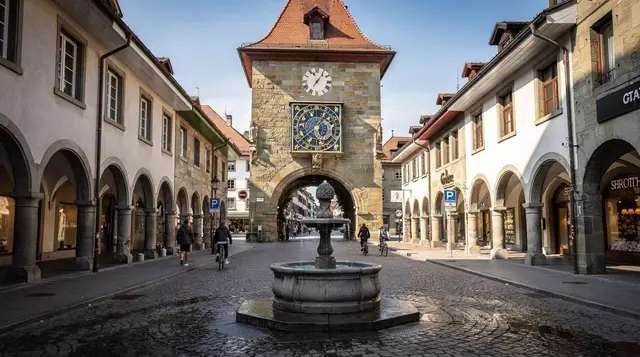
Lucerne’s old town, on the right bank around the Chapel Bridge and Musegg Wall, is the one part of the city where accessibility genuinely gets harder. The lanes are real medieval cobblestone, uneven in places, and some connecting alleys have steps with no ramp alternative. The Chapel Bridge and Water Tower itself is flat wooden decking and manageable; it’s the surrounding street pattern that varies.
The lakeside promenade and the newer left-bank streets around the station are a different story: flat, paved and wide, with dropped kerbs at most crossings. A workable strategy is to treat the old town as a shorter, focused visit rather than a walking route, sticking to Kapellplatz, the riverside path and the main squares, and skipping the steepest connecting lanes up toward the Musegg towers. The full walking route, including which sections are stepped, is covered in the Lucerne old town walking guide.
If covering ground on foot is the sticking point rather than the sights themselves, a seated tour solves it directly. A seated e-tuktuk tour through the old town and along the lake takes in the same landmarks — Chapel Bridge, the Lion Monument, the lakefront — without requiring anyone to walk the cobbles. It’s a genuinely practical option here, not just an alternative for its own sake. A private guide who can set the pace and route around the harder ground is another way to do it: a private walking tour of Lucerne lets you brief the guide in advance on what ground you’d rather avoid.
Toilets and lifts
Public accessible toilets inside the old town are genuinely thin on the ground; most cafés and shops have narrow stairs down to their facilities. The most dependable accessible toilets are:
- Luzern Bahnhof, on the main concourse, free to use
- KKL Lucerne (the concert hall), on the lakeside next to the station
- Manor department store on Weggisgasse
- Museums with admission, including the Swiss Museum of Transport and the Rosengart Collection, both of which have step-free facilities included in the ticket price
Lifts are standard in the station, in KKL, and in newer hotels; older guesthouses in the old town, especially above ground-floor level, may not have one, so it’s worth confirming lift access directly with a hotel before booking rather than assuming from the star rating. See where to stay in Lucerne for how neighbourhoods differ, and choose the flatter, newer-building side of the lake if step-free access to your room matters.
Costs and what accessible transport adds
Assistance itself is free on SBB trains and on the standard boat fleet; you’re not charged extra for a ramp or a member of staff meeting you at the platform. What can cost more is choosing the accessible route over the cheaper one: the Kriens cable car route up Pilatus, for instance, is a similar price to the cograilway, so there’s no real premium there. Where the cost does rise is in swapping a scheduled boat or bus for a private vehicle or charter when standard access on the day is uncertain.
| Option | Typical cost (CHF) | Why choose it |
|---|---|---|
| Standard SBB train with booked assistance | Included in normal fare | Cheapest, works well with advance notice |
| Standard lake boat, standard fare | 15–40 depending on route | Fine on the larger paddle steamers; call ahead to confirm the specific boat |
| Private boat charter | From around 400–600 for a small group | Removes uncertainty about which vessel and pier you’ll get |
| Seated city tour (e-tuktuk) | Roughly 60–90 per person | Covers old-town sights without walking the cobbles |
| Rigi or Titlis cable car and train, standard ticket | 60–100 return depending on route and pass | Both mountains are reliably step-free once booked |
For a general sense of daily costs beyond accessibility-specific spending, see Lucerne travel costs.
A realistic day in Lucerne with reduced mobility
A workable structure: start at the station and lakefront in the morning, where the ground is flat and the boat piers are close by. Take a mid-morning cruise or a seated tour of the old town rather than a walking loop through the stepped lanes. Have lunch on the left bank near KKL or along Pilatusstrasse, where pavements are wide and level.
In the afternoon, head up Rigi or Titlis by the accessible route, allowing extra time at the base station in case a lift or ramp needs a few minutes to arrange. Build in slack rather than a tight connection back, since assistance sometimes takes a little longer to organise than a same-day plan assumes. For a fuller one-day structure to adapt, see Lucerne in one day and adjust the walking sections against what’s above.
Booking transport assistance: the practical steps
- For any SBB train, call 0800 007 102 or use the SBB app’s accessibility booking at least one hour before departure, giving the exact train and platform.
- For lake boats, call the Lake Lucerne Navigation Company or ask at the pier which vessel is running that sailing before boarding.
- For mountain railways, book Rigi or Titlis tickets normally; both have step-free boarding without special arrangement, but arriving in good time avoids being rushed through a busy terminal at peak season.
- For hotels, confirm lift access to your specific room, not just the building, since some older properties have lifts that don’t reach every floor.
- For emergencies, the general number is 112; REGA, the Swiss air rescue service, is 1414 and covers mountain incidents.
None of this requires special equipment or a specialist tour operator to arrange. It requires knowing in advance which parts of Lucerne are genuinely flat, which mountain routes are built for step-free boarding, and where the cobblestones make a scheduled walking route the wrong choice. Plan around those three things and the rest of a Lucerne visit works much like it does for anyone else.
Trip-planning essentials on GetYourGuide
Verified deep-linked GetYourGuide tours. Book through these links and we earn a small commission at no cost to you.
GetYourGuide does not provide a product photo for this activity — the image shows the meeting point, photographed by us.